Improved Image Compressor
Note: Encoder behaviour varies by browser — this tool aims to reach the target or the smallest practical size while preserving quality.
one for Image compress and one for Image Compressor. Each article explains what the tool does, necessary details, step-by-step usage, features, and practical tips. Both avoid misleading claims and include privacy and quality disclaimers so they follow common ad network guidelines.
Image Compressor
Image Compressor is a more advanced browser utility for users who need control over final file size. It lets you enter a target size (in KB), then iteratively compresses and—if necessary—gradually reduces image dimensions until the output meets the requested size within a small tolerance. It combines convenience with smarter heuristics to get closer to an exact target while keeping image quality acceptable.
What the tool does and why it’s useful
Image Compressor aims to produce an output image close to a user-specified byte size. It starts by lowering JPEG quality, then, if quality alone is insufficient, scales down the image dimensions and tries again. This two-stage approach usually yields better results than quality-only compression, particularly for detailed photos that resist quality compression. Like the simpler tool, it operates client-side for privacy and speed.
Key features
- Target size input: Enter a desired output size in KB (for example 200 KB).
- Iterative compression: The tool adjusts JPEG quality in steps and monitors resulting blob sizes.
- Dimension fallback: If quality can’t achieve the target, the image is reduced in dimensions (e.g., scaled to 90% each pass) and retried.
- Tolerance setting: The tool accepts a small percentage above the target (commonly ±2%) to avoid over-shrinking.
- Progress feedback: A progress bar and status messages indicate iterations and current size.
- Downloadable result: After completion, download the final JPEG.
- Client-side safety: All processing happens in the browser; files are not sent to servers.
Step-by-step guide — How to use Image Compressor
- Open the tool: Launch the Image Compressor page in a modern browser.
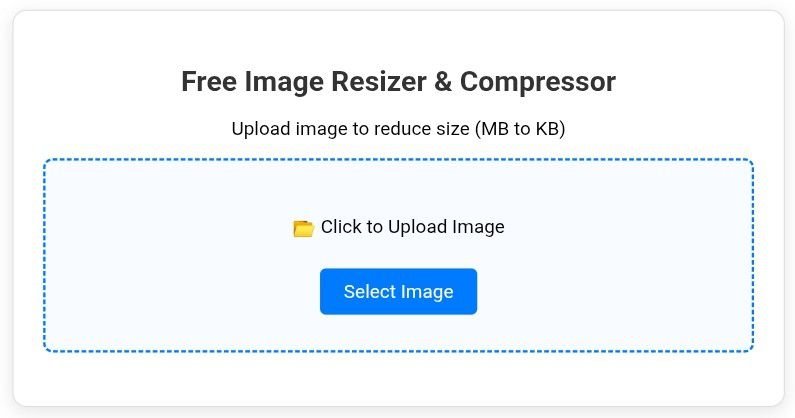
- Choose an image: Click “Select Image” and pick a local file. A preview and original size are displayed.
- Set the target: Enter your desired target size in KB in the provided input (e.g., 350). Optionally leave a note that smaller targets may reduce visible quality.
- Start compression: Click “Start Compress” to begin. The tool will run several quality iterations and, if required, reduce dimensions and retry.
- Monitor progress: Watch the progress bar and status messages showing iteration counts, current quality, or dimension changes.
- Review result: When complete, the tool shows the final file size and dimensions. Inspect the preview to ensure visual quality meets your needs.
- Download: Use the “Download Compressed” link to save the final image.
Practical tips & expectations
- For best visual quality, set targets that are realistic for your image type: 150–400 KB is typical for web photos; very small targets (under 50 KB) will noticeably degrade quality.
- If you need maximum fidelity, prefer larger targets or reduce image dimensions deliberately before compression.
- The tool uses a tolerance window to avoid overshooting. You can adjust tolerance or disable dimension reduction if you prefer strict size guarantees (note: this may produce poor visual results or fail to reach the target).
- Consider offering WebP output if supported by target platforms — WebP often achieves better compression than JPEG without visible loss.
Limitations and privacy
Image Compressor makes a best effort to approach the target size but cannot guarantee an exact byte match across all browsers and images because browser JPEG encoders behave differently. All processing occurs locally in the visitor’s browser, ensuring files remain private unless manually uploaded or shared.
What the tool does and why it’s useful
Image Compressor aims to produce an output image close to a user-specified byte size. It starts by lowering JPEG quality, then, if quality alone is insufficient, scales down the image dimensions and tries again. This two-stage approach usually yields better results than quality-only compression, particularly for detailed photos that resist quality compression. Like the simpler tool, it operates client-side for privacy and speed.
stakemania这名字听起来就很刺激,进去看了一下,果然游戏种类很多,而且画面也很炫酷,体验感不错。想玩就玩stakemania!
Alright guys, checking out cw777 and so far things are looking pretty good. The site’s easy to navigate, and they seem to have a decent selection of games. Will update later after I’ve had a proper go but initial impressions are positive! Give cw777 a shot!
Alright, so I was checkin’ out neo88net the other day. Gotta say, I was pretty impressed! The site’s slick and easy to navigate. Honestly, I had a blast playing around on it. Check it out yourself! neo88net
KG777 is a decent enough site with a good variety of games, keeps you entertained. Give it a shot and see what you think from: kg777.
¡Qué onda, gente! Probé Fundalor Mexico y la verdad me sacó de apuros. Buscaba opciones de fondeo y esta fue la que me convenció más. Échenle un ojo a fundalor mexico, chance y les sirve como a mí.
Alright, time to place some bets! Anyone know how the odds stack up on aposta max? Let’s get some good tips going!
Fancy something sweet? Sugarrushcasino’s definitely got that vibe going on! Loads of bright colors and fun-looking games. I gave it a whirl and it was alright. Worth a look if you’re in the mood for something a bit different. Click here: sugarrushcasino
Richyreels777, eh? Gave it a shot, and it’s your average online casino. Nothing particularly stands out, but it’s not bad either. Selection of games is alright. Have a ganders yourself: richyreels777
Right then, Richy777… Had a play around on the site. It’s alright, nothing too crazy. Seems like a decent enough place to have a bit of a flutter. Judge for yourself here: richy777
Best experience I’ve had in a while. Everything is set up perfectly and the customer support team is very helpful and polite. 33jilicom
The app download was quick and the installation was seamless. Now I can play on the go whenever I want. Such a convenient setup. plus777asiadownload
Everything from registration to the first win was seamless. It’s a reliable spot for anyone looking for quality gaming. Highly recommend k444bet.
Great selection of slots and the jackpots are actually real. I had a huge win last night and the withdrawal was instant. Love vnnk88nohu so much.
The registration process was super easy and I was playing within five minutes. Very intuitive design and great game selection on phsigi777.
Best mobile experience so far. The graphics are top notch and ggjiliapp runs perfectly on my phone.
I really enjoy the atmosphere here. The winning streaks have been amazing lately and the registration was a breeze. Visit vngen88 for some action.
Super impressed with the customer support here. They answered my questions in minutes. I’m really enjoying my time on jljl99login.
Great app performance and very stable connection. It is rare to find such a reliable platform these days. Give 09btapp a try if you want a stress-free experience.
Been spinning slots and testing the table games here for a few weeks now. The community vibe is awesome and payment options cover everything I need. Keep up the great work with the regular promotions. pkbet77
The ability to set an exact target file size in KB is super handy, especially for strict upload limits. It is great that it handles everything client-side for better privacy, too!
The dimension fallback feature is really smart for hitting strict upload limits when quality tweaks alone aren’t enough. Plus, having everything run client-side for privacy is a huge bonus.
Having the option to set a specific target KB size is super handy for web uploads with strict limits. Love that it handles the compression client-side too for better privacy!
Really impressed with the variety of games available here. There is always something new to try out. ak777bet
Really appreciate that this runs entirely client-side for privacy. The fallback to automatically scale dimensions when quality compression isn’t enough is super handy for hitting strict upload limits!
If you are looking for a place with a great community and exciting games, this is it. The overall vibe is just right and it feels very trustworthy. Join phfun999login
Being able to set an exact target size in KB is super helpful, especially for strict upload limits on forums or wikis. Love that it processes everything client-side for privacy too!
Being able to set a specific target KB size makes handling strict upload limits so much easier. I also appreciate that the compression runs client-side for better privacy.
Being able to set a specific target size in KB is super convenient, especially for sites with strict upload limits. Love that it processes everything client-side for privacy and speed!
Being able to set a specific target file size in KB is super helpful, especially for portals with strict upload limits. Love that it processes client-side for better privacy and speed too!
Being able to set a specific target size in KB is super helpful, especially for sites with strict upload limits. Love that it processes everything client-side in the browser too!
Being able to target an exact file size in KB is super helpful for strict upload limits. Love that it processes everything client-side for privacy as well!
Being able to set an exact target size in KB is a lifesaver for sites with strict upload limits. I especially appreciate that it processes everything client-side to keep images private.
The ability to set an exact target size in KB is super convenient, especially since it automatically scales dimensions if quality adjustment isn’t enough. It is also great that everything runs client-side for privacy.
The ability to set an exact target KB size and let it automatically adjust dimensions if needed is super helpful. Love that it processes everything client-side too for privacy.
The community here is amazing and the rewards are top notch. I’ve had some lucky wins lately and the withdrawal process was surprisingly fast. Big thanks to phponeclub.
Being able to set an exact target file size in KB and have the tool automatically handle both quality reduction and dimension scaling makes optimizing images so much easier. It’s especially nice that everything runs directly in the browser for privacy.
I really like that it scales down the dimensions as a fallback instead of just ruining the JPEG quality. Processing everything locally in the browser for privacy is a huge plus, too!
Being able to hit an exact target file size in KB is super helpful, especially for strict upload limits. Great that it runs client-side too for fast processing and privacy.
Being able to set a specific target file size in KB instead of just guessing quality percentages is super helpful. I really appreciate that it handles everything client-side for better privacy, too.
Being able to set a specific target size in KB is super handy, especially for upload forms with strict file limits. Love that it processes everything client-side for privacy, too!
The two-stage compression approach with dimension fallback is super smart. Setting an exact target size in KB saves so much time compared to manually tweaking quality sliders back and forth!
The jackpot hits here feel way more frequent than on other sites. It is such a thrill every time I spin. I am totally hooked on slotmax.
The two-stage approach of adjusting quality first and then scaling dimensions is really smart. Having a client-side tool that lets you hit an exact target file size makes optimizing images so much easier.
Being able to set an exact target size in KB is super helpful, especially with the automatic dimension fallback. Love that it processes everything client-side for privacy, too!
The dimension fallback heuristic sounds convenient, but automatically downscaling dimensions can backfire on academic portals that enforce strict minimum pixel resolutions for student IDs. I ended up cross-referencing application requirements via the [[LINK]] while troubleshooting my rejected upload, so having a toggle to prevent resolution reduction would be a great safeguard.
Super smooth gameplay and no lagging at all. The registration process was a breeze and I started winning almost immediately. Visit vnnohu56com now.
Really impressed with the variety of games available here. It’s definitely one of the top choices for players in the Philippines. Check out phpin777 if you want some real action.
Lowering JPEG quality alone often fails to shrink detailed graphics without ruining them, so explaining why iterative dimension scaling is necessary clears up a huge misconception. We ran into this exact issue while packaging high-res character captures from [[LINK]] into our digital presentations without exceeding strict LMS upload limits.
Best betting experience I’ve had in a while. The odds are competitive and the customer support team is actually helpful. Definitely sticking with br76xbet from now on.
Seeing that detailed photos often completely resist quality-only compression until you force dimension downscaling was quite surprising, and while prepping banner assets for the [[LINK]] layout revamp, relying on that two-stage fallback saved us from terrible compression artifacts.
Setting a strict target size with automatic dimension fallback makes sharing high-res stat sheets effortless for anyone starting today. After shrinking down screenshots of my gear, checking the numbers through this [[LINK]] showed me exactly where to prioritize my next upgrades without running into strict forum upload limits.
Short, sweet, and simple. Exactly how a gaming site should be. I love how fast the registration is on kr86.
Relying on dimension fallback to hit an exact KB target keeps static asset hosting practically free, an unmentioned perk for remote creators checking to see if their portfolio can coast without high monthly business overhead. Trimming every unnecessary kilobyte helps keep operational burn rates tiny enough that early retirement milestones arrive much sooner.